In this series of guest posts, presenters at conferences hosted or empaneled by Ceræ: An Australasian Journal of Medieval and Early Modern Studies briefly discuss their work, interests, and methods. Today, we welcome Brooklyn Arnot. Brooklyn is currently a DPhil candidate at the University of Oxford. Her thesis examines Christian themes in the fornaldarsögur, considering aspects such as the use of Biblical typology and parallels to saints’ lives. Brooklyn’s paper at the 2025 Cerae Conference was titled, “A Heathen Paradise: An Analysis of Glæsisvellir in the Old Norse Legendary Sagas.” It explored the strange and uncanny otherworld in Old Norse literature known as Glæsisvellir, considering its parallels to Christian texts. She reflected on how depictions of Glæsisvellir in post conversion Iceland might have drawn inspiration from Christian representations of purgatory. Brooklyn also illustrated her presentation with watercolour illustrations which she had painted herself, so we look forward to asking her about how she brings together her academic and creative practices.

“Glæsisvellir” by Brooklyn Arnot
1. What projects are you currently working on (if you are able to divulge them!)?
During the writing of my masters’ thesis, I became obsessed with Saint Margaret, who became popular in the Middle Ages as a saint associated with childbirth, despite her herself being a virgin. Saint Margaret is also a unique saint because at some point in her story she is eaten by a dragon. She manages to escape from this dragon by making the sign of the cross, bursting out of it, and killing it, making her a female dragon slayer. I became interested in how this saga expresses ideas of death and rebirth, and the multi-layered associations we can make with the belly of the dragon, such as Jonah’s belly of the whale, the tomb of Christ, hell, and the womb of a mother. I have painted several images which have helped me explore and visually understand the relationships between these layers. I hope to turn these into an exhibition, largely conceived of by my academic-and-artist-friend Marie Sophie Besson (Instagram: @marie.giboulee.art), exploring Iceland, layers of reality, and landscape.
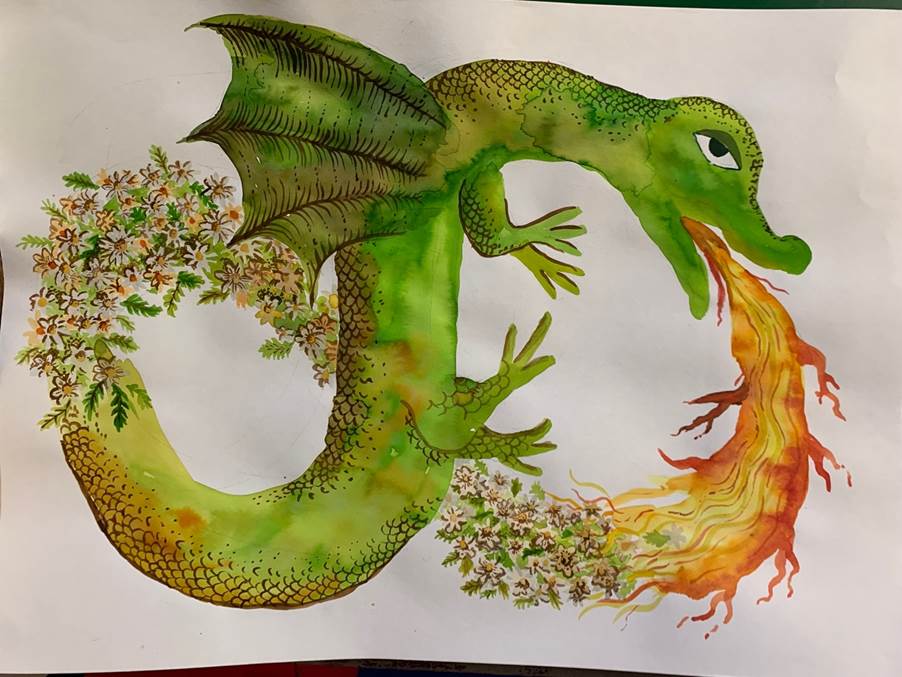
“Rebirth” by Brooklyn Arnot
I have also been working on an epyllion called ‘Lucia’s Vision.’ This poem is loosely inspired by another female Saint, Saint Lucia. However, it also includes a scene based on the dragon devouring episode in Saint Margaret’s story. This poem will be illustrated, so I can bring my passions of art, poetry and the Middle Ages together.
2. What are you currently reading for fun?
I’m reading Gene Wolfe’s The Book of the New Sun, a strange and disorienting tetralogy of fantasy/science fiction. Not only is this book delightful to read, but it also engages with my academic interests as it uses the medieval exegetical technique of Biblical typology and alludes to Old Norse literature.
3. What is a book that you would recommend to someone who enjoyed your presentation at the conference and wants to learn more? Are there any other researchers whose work you would recommend?
The main academic book I drew upon in my presentation was Aisling Byrne’s Otherworlds: Fantasy and History in Medieval Literature. She develops the concept of a tertiary world, which is an extension of Tolkien’s distinction between a primary world (reality) and a secondary world (fiction). The tertiary world is another world within the world of fiction. These worlds have fertile ground for analysis, as they engender comparison between themselves, secondary worlds, and primary worlds, and provide fields to explore concerns which might be difficult to articulate in the primary world. I would strongly recommend reading Byrne’s work, as it has been instrumental to the development of my ideas. I should give a shout-out to another Old Norse academic, Timothy Liam Waters, for introducing me to both Byrne’s scholarship and The Book of the New Sun.
4. Your practice as a medievalist is intertwined with your creative process. Can you talk more about how you marry the creative and the medieval as an artist, or how art informs your academic outlook?
One of the things that draws me to medieval literature and art is the way any given image or plot point can have layers upon layers of meaning. A single incident in an Icelandic saga might remind the audience of various Biblical or mythological episodes at once. These layers of meaning sometimes create paradoxes, which medieval people often sit comfortably within. I’m inspired by these elements of medieval art and literature in my own creative practice; I try to thicken my work with layers of meaning and sit in the difficult spaces of hard questions and paradoxes.
On a more practical level, one way I bring together my academic and creative pursuits is by using my art in academic conferences, just like I did for the 2025 Cerae conference. An academic conference gives me a deadline and parameters which allow my art to flourish. Some of my favourite artworks I have created in the last year have come out of a need to visually represent my ideas at conferences.

“Ingibjörg’s Feast” by Brooklyn Arnot
6. Where can we find you on social media?
I post my art on @arnot.art on Instagram.