In this guest post, our secretary and treasurer Dr. Michele Seah and conference presenter and deputy reviews editor Quinn Bouabsa Marriott give their impressions of the 2025 International Medieval Conference at Leeds. We’re so glad to have their perspectives on the conference as attendees, moderators, and presenters!
Michele Seah
The University of Newcastle, Australia
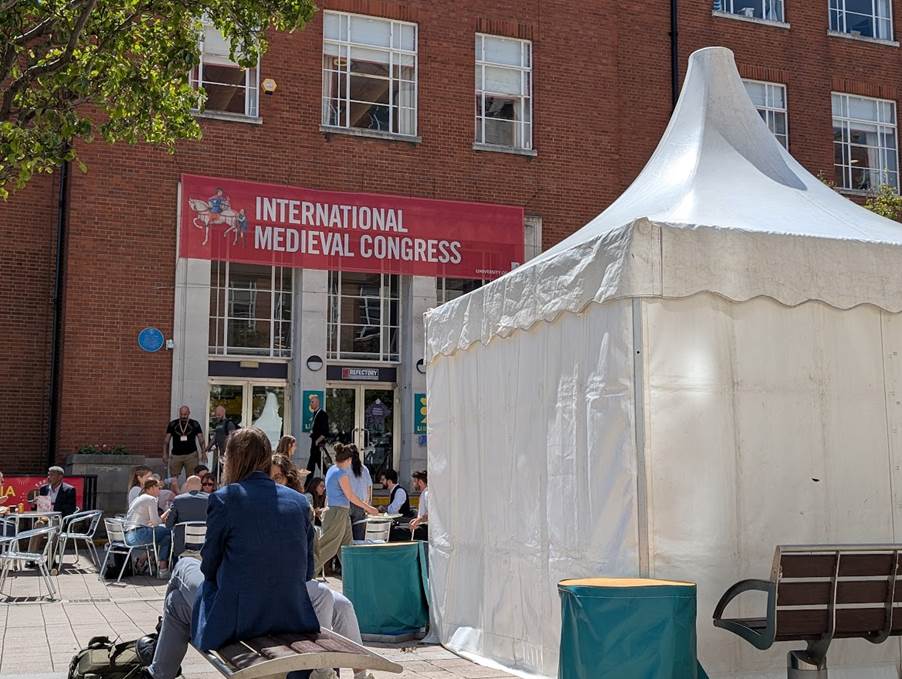
The last time I attended the International Medieval Conference in person was in 2018 and I had forgotten how very enjoyable it is to join sessions at different venues at the University of Leeds. I took the picture above while sitting, having lunch in the sunshine and catching up with old friends.
I came to the IMC this year to present in a Royal Studies Network session and to moderate two of our three Ceræ sessions. IMC is now fully established as a hybrid event and that has been a boon for so many people. Two of the speakers for the second Ceræ session, s1612, had planned to come to Leeds in person but had to change their registration to virtual. So, happily for us, they were able to present their papers after all.
As always, I was interested in far too many sessions to be able to attend them all but I am so glad to be able to catch up by listening to recordings. Besides the many sessions related to gender research, queenship and royal studies that are directly relevant for my research, I can indulge my interest in topics as varied as medieval recipes, castle studies and archaeological artefacts (s714, s234, s321). I’ve also listened to debates such as those on digital teaching and the use of AI (s438), and what terms such as ‘medieval’ and ‘history’ mean for us today (s227, s327).
Quinn Bouabsa Marriott
University of St Andrews
For my part, this was my fourth year in-a-row attending the IMC since 2022 and, while it was good to meet again with old faces from my time as a Masters student at the University of Leeds, there was also something refreshing about coming down as a student of St Andrews, alongside a new community of friends from among my cohort and faculty alike.
In previous years, my presence at the IMC had only been as a spectator, but this time around, as a first-year PhD student, I decided to involve myself much more directly, presenting my very first conference paper on my thesis as well as act as moderator for sessions organised by the Network for the Study of Mongol Eurasia, tied directly to my own field of research.
On top of all this, of course, I helped run the last of our Ceræ sessions (s1712) as moderator on the final day of the conference. While unfortunately one of our three speakers had to cancel due to illness, our other two participants, Robyn McAuliffe and Pamela Kask, managed to attend and were thankfully able to make it to Leeds to deliver their papers in-person. Even though this was the very last session of the conference, the turnout was positive, and we enjoyed a lively discussion afterwards on topics ranging across the two papers: the presence and identification of trauma in Old English poems as well as the ways in which women were shown to engage with knowledge in the works of Chaucer.
This was a great opportunity to once again take a step out of my field of familiarity and admire both the scope and variety of papers produced by our colleagues year-on-year, both far and wide.
Thank you again to Dr. Seah and Quinn for their report. Ceræ will be sponsoring panels at the 2026 International Medieval Conference – be on the lookout for our Call for Papers!
Coming up next on the blog: an interview with a presenter at one of Ceræ’s sponsored panels at IMC 2025.
Image credit: Dr. Michele Seah